TL;DR
For some “bright strugglers,” standard school phonics programs fail because the child’s “auditory hardware” isn’t ready for the “literacy software.” If a child can’t distinguish or hold onto sounds (auditory processing), doubling down on phonics only leads to frustration.
Phonics programs – if you’re finding they aren’t working for your child, you aren’t alone.
In most Australian primary schools, synthetic phonics (like MacqLit or similar classroom programs) is the go-to method for teaching reading. For many children, it works beautifully. But for a specific group of “bright strugglers,” phonics feels like an uphill battle that never seems to end.
Your child might know their individual letter sounds in isolation, yet when it comes to the complex task of blending them into a fluent word, they disconnect.
You might notice that they successfully decode a word on one page, only to encounter it on the very next page as if they’ve never seen it before. It’s a frustrating cycle where the spelling words they mastered yesterday feel like completely new, unfamiliar content by the next morning. Often, these children manage to pass a weekly spelling test through sheer, exhaustive memorisation – only for those words to vanish from their memory by Monday morning because the underlying “anchor” for the sound wasn’t there.
As an OT with over 20 years of experience, I’ve found that when phonics “won’t stick,” it’s rarely a problem with the teaching or the child’s effort. It’s usually a sign that the auditory hardware isn’t ready for the phonics software.
The literacy hierarchy: What comes before phonics?
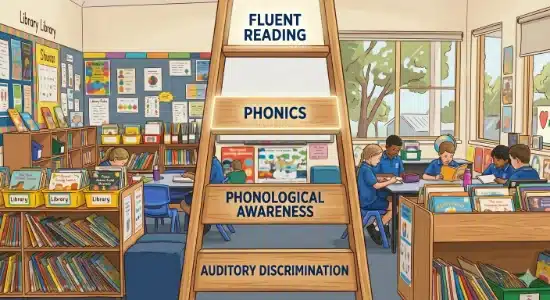
Think of reading as a ladder. Phonics is a high rung on that ladder, but there are several invisible rungs underneath it that support a student’s weight.
- Auditory discrimination: Can the brain tell the difference between “cap” and “cup” in a noisy room?
- Phonological awareness: Can the student “play” with sounds in their head? (e.g. “What is stray without the s?”)
- Phonics: Mapping those sounds to the letters on the page.
If a child’s brain struggles to distinguish or hold onto sounds (Auditory Processing), then phonics becomes incredibly confusing. They aren’t “bad at reading”; they are trying to build a house on a foundation that hasn’t been poured yet.
Why more practice on phonics programs often leads to more frustration
When a child isn’t progressing, the standard response is often “double down” – more tutoring, more flashcards, or repeating the phonics level.
But if the bottleneck is in the processing, simply doing more phonics is like trying to listen to a radio station with heavy static. Turning up the volume doesn’t make the music clearer; it just makes the static louder. This is why these children often become tired or avoidant during reading – their brains are working five times harder than their peers just to make sense of the noise.

Tuning the signal
The good news is that the brain is remarkably adaptable. Through targeted, intensive training, we can actually “tune” the auditory system.
Before we ask a child to look at a page and decode, we can help them:
- Sharpen their ability to hear the tiny differences between fast speech sounds.
- Expand their working memory so they can hold a sequence of sounds long enough to blend them.
- Filter out background noise so the teacher’s voice (and the phonics instruction) becomes the primary signal.
When we strengthen these cognitive foundations, the phonics programs the school provides suddenly start to click. The “software” finally has a stable platform to run on.
If your child is working hard but falling behind, it’s worth looking below the surface. You don’t necessarily need more tutoring; you might just need to train the brain to hear the sounds that phonics is trying to teach.

Is your child’s reading foundation as strong as it could be?
If the “phonics-first” approach isn’t yielding the progress you expected, it may be time to look at the cognitive building blocks underneath. We provide two ways to help you identify the missing piece:
Take our screening assessment
Not sure if it’s a processing or memory bottleneck? Our 5-minute screening tool provides a summary of your child’s learning profile and helps identify if cognitive training is the right next step.
Start now by clicking here.
Book a complimentary consultation
Speak with one of our learning specialists to discuss your child’s specific learning needs and to understand if our courses are a right fit. Reach out to us to book a free phone consultation to discuss how we can help.